

You have a Rails app. Customers keep asking for a mobile app. You start looking at options.
Rewriting in Swift and Kotlin means two new codebases your team doesn’t know. Hiring an agency means $80k, six months, and an app that drifts out of sync every sprint. WebView wrappers feel like a chrome-less browser, and review rejects them without native components. React Native and Flutter add a third codebase in a third language that still doesn’t talk to your Rails backend natively.
You’re a Rails developer. Your team ships web features in days. Why does mobile take a year?
Hotwire Native is the closest anyone has gotten. It wraps your Rails views in a native shell, with native navigation and transitions between screens. I wrote the book on it. But it solves the rendering problem, not the shipping problem. You still have to open Xcode and Android Studio. You still have to learn enough Swift and Kotlin to be dangerous. And you still have to figure out everything that happens between “it runs on my simulator” and “it’s in the App Store.”
“But AI can write Swift now.” Sure. Claude will happily generate a UIKit view controller. It will not generate your Apple Developer account, your provisioning profile, your TestFlight build, or your review submission. And every time you ship a feature on the web, AI gets to write it three more times: once in Swift, once in Kotlin, once to keep the API in sync. A webview-based app gets all of that for free.
The code was never the hard part.
Whether you go fully native, hire it out, or use Hotwire Native, you still need Xcode and Android Studio. Apple Developer and Google Play accounts. Signing certs and provisioning profiles. A mobile CI pipeline. App Store Connect setup, TestFlight, beta groups. Swift and Kotlin bridge components. In-app purchases wired to your backend. Fresh screenshots, metadata, and review notes every release.
That’s the wall. It’s not the rendering, it’s the shipping.
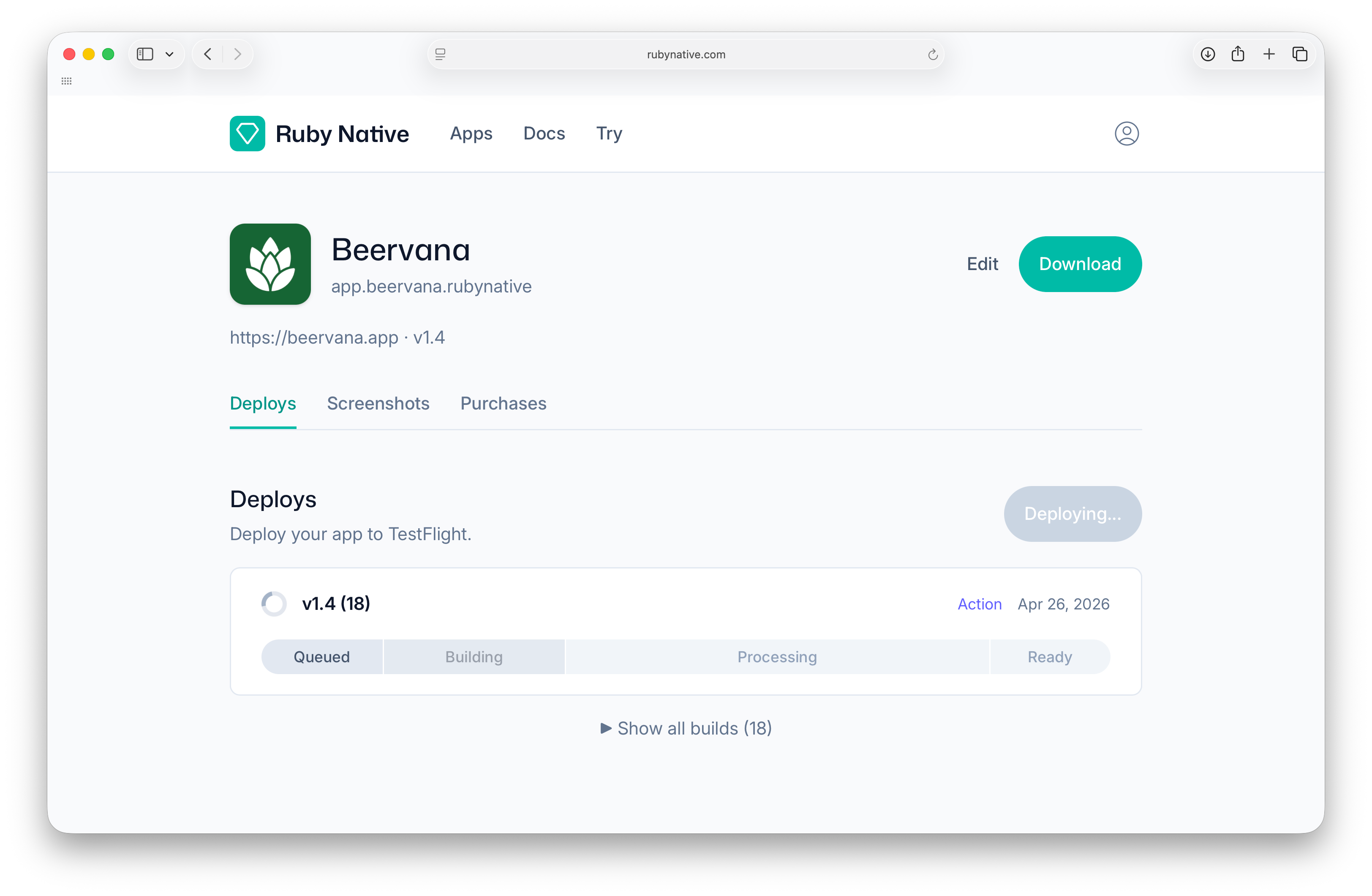
Ruby Native is the layer that handles everything else. You add a gem to your Rails app, configure it with a YAML file, and run bundle exec ruby_native deploy. We build, sign, and ship the binary to TestFlight or the App Store. Native tabs, navigation, in-app purchases, and push notifications are all driven from your Rails views with a few helper tags.
Beervana is live on the App Store right now, and I never opened Xcode to ship it.
Today Ruby Native ships iOS apps. Android is in active development and coming next.
If you have a Rails app and customers asking for mobile then this is for you. Plans start at $299/year.
Use code LAUNCH100 for $100 off your first year. Expires in two weeks (May 18).